For years, people have repeated the same relationship advice:
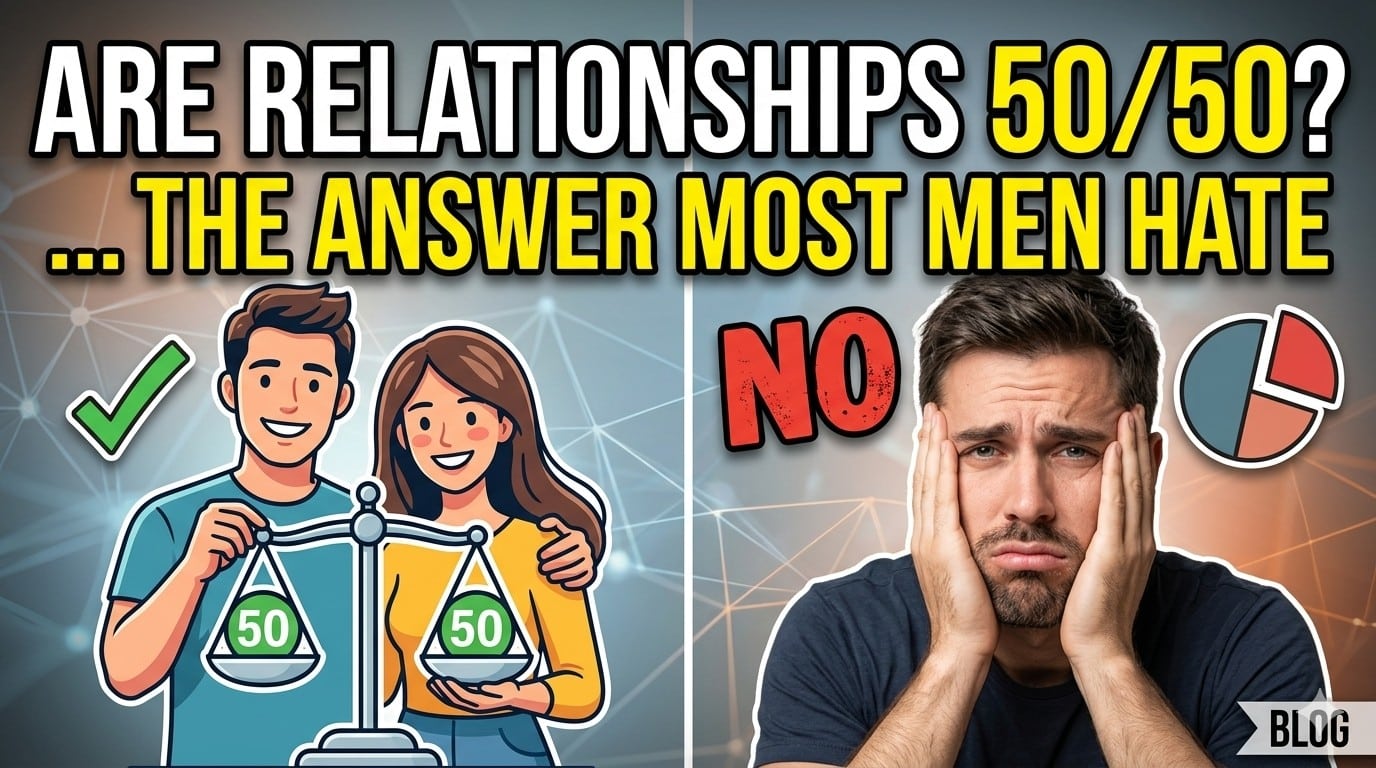
“A relationship should be 50/50.”
It sounds fair.
It sounds balanced.
It sounds like the perfect formula for love.
But when you step into real relationships, something quickly becomes obvious:
Relationships are rarely 50/50.
Some days they are 70/30.
Other days they are 80/20.
Sometimes they feel like 90/10.
And during the hardest seasons of life, one partner may carry almost everything.
The truth most relationship experts avoid saying out loud is simple:
Healthy relationships are not about splitting everything exactly down the middle.
They are about mutual commitment, trust, and the willingness to step up when your partner cannot.
For many men, this truth is frustrating.
Because while society talks about equality, many relationships still expect men to give more — emotionally, financially, and mentally.
So the real question is not whether relationships should be 50/50.
The real question is:
What does a healthy balance actually look like in modern relationships?
Let’s break it down.
The Origin of the 50/50 Relationship Idea
The concept of a 50/50 relationship became popular in modern discussions about equality.
As societies evolved and gender roles changed, the idea was simple:
Both partners should contribute equally.
This meant:
- Equal emotional investment
- Equal financial responsibility
- Equal household duties
- Equal decision-making power
On paper, this sounds perfectly reasonable.
But relationships are not business contracts.
Human beings are emotional, complex, and constantly changing. That means no relationship can stay perfectly balanced at all times.
Life simply doesn’t work that way.
Why Relationships Can Never Truly Be 50/50
Imagine two people in a relationship.
One person loses their job.
The other person gets promoted.
At that moment, the relationship instantly becomes unbalanced.
One partner may now contribute more financially.
Later, the situation might reverse.
One partner may become emotionally overwhelmed because of family issues, stress, or health challenges.
The other partner may have to provide more emotional support.
In these moments, expecting strict equality can actually damage the relationship.
Because love is not about keeping score.
It is about showing up when the other person needs you most.
The Dangerous Side of the 50/50 Mindset
While equality is important, the obsession with perfect balance can create serious problems.
Some couples begin to treat their relationship like a scoreboard.
They start thinking things like:
- “I did the dishes yesterday, so it’s your turn.”
- “I paid for dinner last time.”
- “I supported you emotionally last week.”
This mentality slowly turns love into a competition of effort.
Instead of giving freely, partners begin calculating what they are owed.
When this happens, resentment starts growing quietly beneath the surface.
Healthy relationships require fairness, but they also require generosity and flexibility.
Without those qualities, the relationship becomes transactional instead of emotional.
Why Many Men Struggle With the 50/50 Idea
For many men, the concept of relationship equality feels confusing.
On one hand, modern culture encourages equality in relationships.
On the other hand, many men still feel traditional expectations placed on them.
For example, many men feel pressure to:
- Be the primary provider
- Pay for most dates
- Initiate romantic gestures
- Protect and lead the relationship
At the same time, they are told relationships should be perfectly equal.
This contradiction leaves many men wondering:
“If relationships are supposed to be 50/50, why do I feel like I’m expected to give 70 or 80 percent?”
This question fuels many modern debates about dating and relationships.
But the real issue is not equality itself.
The real issue is unspoken expectations.
When expectations are unclear, relationships become frustrating for both partners.
The Reality: Relationships Move in Seasons
Every relationship goes through different phases.
There are moments when both partners are thriving.
During those times, the relationship may naturally feel close to 50/50.
But there are also difficult seasons.
For example:
One partner might be dealing with depression.
Another might be facing career stress.
Someone might be struggling financially.
Someone else might be experiencing family conflicts.
During those periods, expecting equal contribution can be unrealistic.
Strong couples understand something important:
Balance in relationships happens over time, not every single day.
Over months and years, effort naturally shifts back and forth.
This is what creates long-term stability.
The True Formula of Healthy Relationships
If relationships are not 50/50, what should they be?
The healthiest couples often follow a different principle.
Instead of focusing on equality, they focus on mutual dedication.
That means each partner tries to give 100% of what they can at the moment.
Some days that may look like:
- emotional support
- patience
- financial help
- encouragement
- compromise
On other days, it may simply mean showing kindness when your partner is struggling.
The key difference is intention.
Healthy relationships are not about giving the same amount.
They are about both partners genuinely trying.
Signs Your Relationship Balance Is Healthy
Even though relationships are not perfectly equal, they should still feel fair.
Here are some signs your relationship has a healthy balance.
Mutual Respect
Both partners value each other’s feelings, time, and effort.
No one feels constantly ignored or dismissed.
Emotional Support
Partners listen to each other and offer comfort during difficult moments.
Emotional connection strengthens the relationship over time.
Shared Responsibility
Both partners contribute to maintaining the relationship in meaningful ways.
This includes communication, effort, and problem-solving.
Appreciation
Healthy couples regularly acknowledge each other’s efforts instead of taking them for granted.
Simple appreciation can prevent resentment from building up.
Signs the Relationship Is One-Sided
While relationships do not need to be perfectly equal, they should never feel completely one-sided.
Here are warning signs something may be wrong.
Only One Person Initiates Effort
If one partner always plans dates, starts conversations, and solves problems, the relationship may lack balance.
Emotional Needs Are Ignored
When one partner consistently dismisses the other’s emotions, resentment grows quickly.
Lack of Appreciation
Feeling unappreciated for long periods can damage even the strongest relationships.
Constant Exhaustion
If the relationship feels emotionally draining rather than supportive, something needs to change.
Healthy relationships should feel challenging sometimes, but they should not feel like a constant battle.
Why Modern Relationships Feel Harder Than Before
Many people believe dating and relationships have become more complicated in recent years.
There are several reasons for this shift.
Changing Gender Roles
Traditional relationship expectations are evolving, but many couples have not fully defined their new roles.
Social Media Influence
Constant exposure to other people’s “perfect relationships” can create unrealistic expectations.
Financial Pressures
Modern life brings financial stress that can strain even loving partnerships.
Communication Gaps
Many people enter relationships without strong communication skills.
Without clear communication, misunderstandings grow quickly.
All of these factors make the idea of a simple 50/50 relationship much more complicated than it sounds.
What Real Relationship Equality Actually Looks Like
True equality in relationships does not mean identical effort.
Instead, it means both partners feel valued and supported.
Real equality includes:
- equal respect
- equal voice in decisions
- equal emotional safety
When these elements exist, relationships naturally become healthier.
The focus shifts from counting contributions to building a strong partnership.
This mindset creates deeper trust between partners.
The Most Important Question Couples Should Ask
Instead of asking:
“Is our relationship 50/50?”
Couples should ask something much more powerful:
“Do we both feel supported and appreciated?”
If the answer is yes, the relationship is likely on the right track.
If the answer is no, then deeper conversations need to happen.
Open communication is the foundation of long-term love.
Without it, even the most balanced relationship can slowly fall apart.
How Couples Can Create Better Relationship Balance
If you feel your relationship lacks balance, there are ways to improve it.
Communicate Honestly
Discuss expectations openly.
Many conflicts happen because partners assume things instead of discussing them.
Express Appreciation
Acknowledging effort strengthens emotional connection.
Even small gestures of gratitude can make a big difference.
Share Responsibilities
Discuss how responsibilities can be distributed fairly in ways that work for both partners.
Support Each Other’s Growth
Healthy relationships encourage personal development instead of limiting it.
Partners who grow together tend to stay together longer.
The Brutal Truth Most People Avoid
At the end of the day, the biggest relationship truth is simple.
The success of a relationship does not depend on perfect equality.
It depends on mutual care and consistent effort.
If both partners genuinely want the relationship to work, they will find ways to support each other during both good and difficult times.
But if one person stops trying entirely, the relationship begins to collapse.
Love cannot survive on the effort of only one person.
Final Thoughts
So, are relationships supposed to be 50/50?
In theory, equality is a beautiful goal.
But in real life, relationships are far more dynamic.
Some days they will feel balanced.
Other days one partner may need to carry more of the emotional weight.
What truly matters is not the exact percentage of effort.
What matters is whether both partners continue choosing each other, supporting each other, and growing together.
Because when two people are committed to doing that, the relationship becomes something much stronger than a simple equation.
It becomes a partnership built on trust, loyalty, and genuine connection.
And that is far more powerful than any 50/50 formula.
GET OUR GUIDE BOOKS BELOW
1. Mastering Seduction: How Men Create Desire Without Chasing or Begging
Stop chasing.
Start being chased.Stop chasing and start being chosen
This is more than a book—it’s your blueprint for becoming the man women are drawn to, remembered, and obsessed with.
🔥 Don’t wait—get your copy now and start transforming your love life today! 👇👇👇
https://nomorewastedman.gumroad.com/l/MasteringSeduction2. Magnetic Texting: How to Spark Attraction Through Every Message
Stop overthinking your texts.
Stop sending paragraphs.
Stop double texting.
Stop chasing women who reply with “lol.”Your problem is not women.
It’s how you text.Every message either builds attraction…
Or kills it.Become the man whose phone buzz makes her smile.
Not the man she replies to when she’s bored.MEN, FIX YOUR GAME. SAVE YOUR OPTIONS.
⚡ Get your copy now and learn how to spark attraction through every message:
👉 https://nomorewastedman.gumroad.com/l/MagneticTexting3. What Women Really Want in a Man: The Alpha Traits Women Respect and Desire
You’re not ignored because you lack looks.
You’re ignored because attraction grows from certainty — not compliance.
Inside this guide you’ll learn:
✅ The alpha mindset without toxic dominance
✅ How to lead without controlling
✅ Why women follow men with purpose
✅ Emotional control that builds respectBecome the man she doesn’t question — she trusts.
👉 Get the book now.
https://nomorewastedman.gumroad.com/l/WhatWomenReallyWant